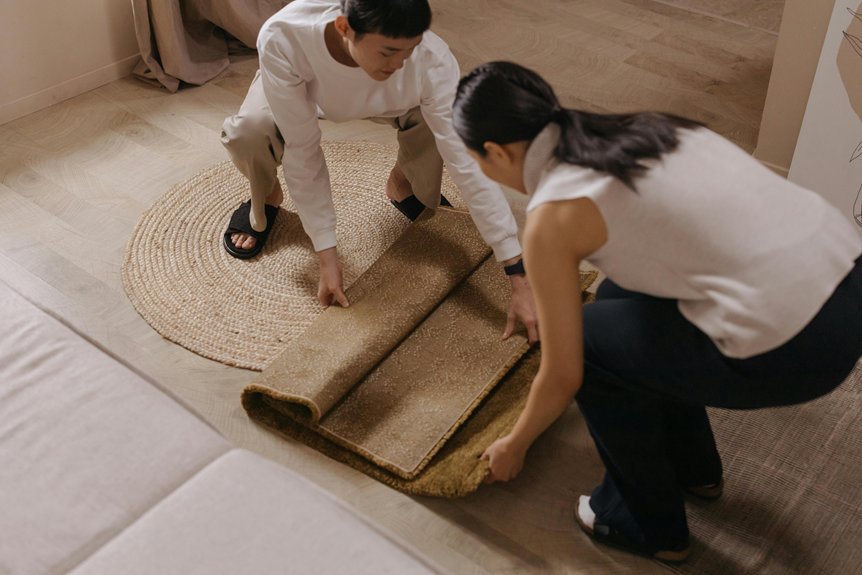
Start by measuring your seating area’s length and width—this tells you what you’re working with. I’d aim for that 6- to 8-inch extension beyond your sofa on each side; it provides visual balance. Don’t forget wall clearance: keep at least 18 to 24 inches from the edges depending on your room size.
Match standard sizes to your space—think 6×9 for small rooms, 8×10 for mid-sized ones. Avoid those common mistakes like rugs that feel too small or sit too close to walls. Get the specifics on each approach coming up.
Measure Your Furniture First: The Foundation of Rug Sizing
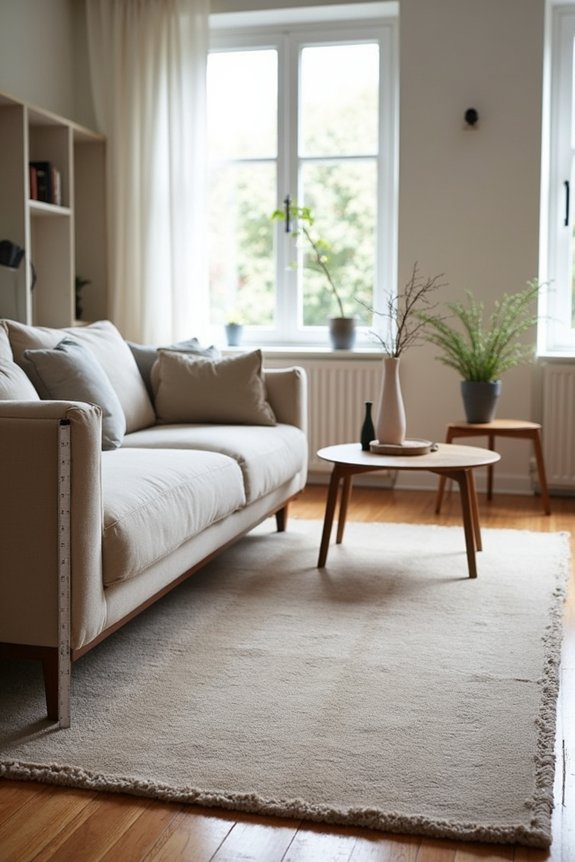
The foundation of any good rug decision starts with measuring your furniture—and I mean really measuring, not just eyeballing it from across the room. Here’s what I do: I measure your seating area first, noting the sofa length and width. This tells me how much space I’m actually working with. Next, I determine how far the rug extends beyond your sofa—aim for at least 6 to 8 inches on each side for balanced room proportions. Then comes placement: position the front legs on rug while back legs stay on the floor for that balanced look. Finally, I account for walking clearance around furniture pieces, maintaining 18 to 36 inches between major items depending on your room size. These measurements guide your entire rug placement strategy.
Use the 6- to 8-Inch Rug Rule to Balance Proportions
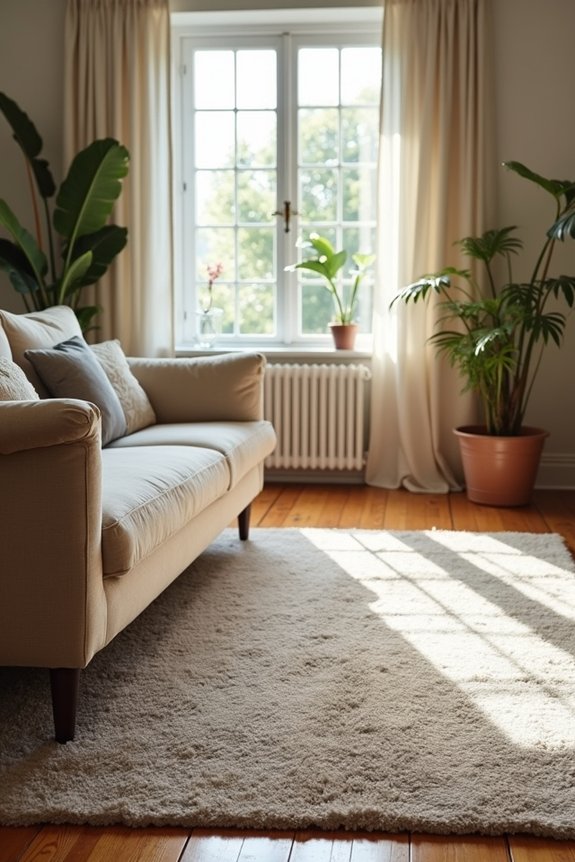
How do you know if your rug is actually the right size, or if it’s just floating awkwardly in your living room?
I use the 6-8 inch rule to nail balanced proportions every time. Here’s what I do:
- Extend 6 to 8 inches beyond your sofa’s arms on each side for that grounded feel
- Position front legs on the rug so your seating area feels anchored
- Aim for 8 inches when space allows, creating a cohesive layout that ties everything together
This simple guideline prevents your rug from overwhelming the space or leaving too much bare floor exposed. When your chairs and sofa rest on the rug, you’re creating a unified seating area that actually feels connected. In smaller living rooms, I maintain 18–24 inches from walls while keeping this balance. This rule works consistently—your room will feel more put-together and intentional.
Account for Wall Clearance Before Committing to a Size
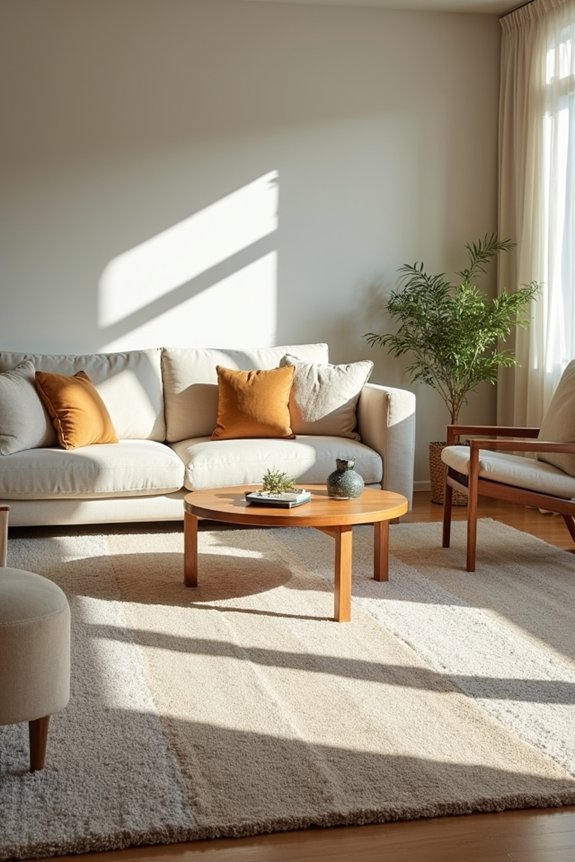
Wall clearance makes or breaks whether your rug looks intentional or cramped—and I’ve learned this the hard way. When you’re selecting rug size, you can’t ignore how much space remains between where your rug extends and the walls. In larger living rooms, I aim for at least 24 inches of clearance from each wall edge. Smaller rooms need a minimum 18 inches to maintain proper room flow. Here’s what I’ve discovered: when your front legs rest on the rug while maintaining these clearances, your seating area feels grounded yet spacious. Your room dimensions determine everything. I always measure twice, checking that adequate space clearance exists around furniture before finalizing rug placement. This approach prevents that suffocating wall-to-wall feeling and keeps your living room functioning naturally.
Match Standard Rug Sizes to Your Room Shape
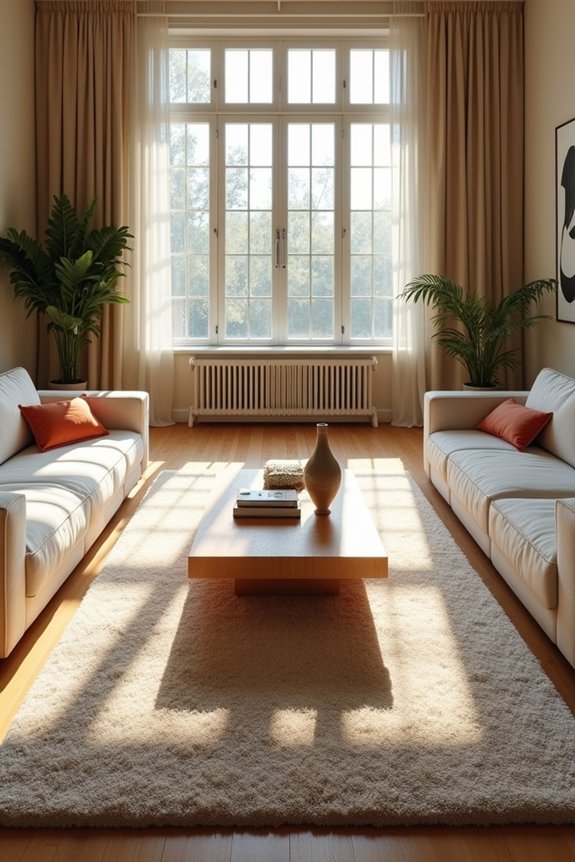
Once you’ve figured out your wall clearance, it’s time to match your room’s dimensions to a standard rug size—and this is where things get straightforward.
Matching rug sizes to your living room shape makes space planning easier. Here’s what works:
- Small rooms (under 11′ x 13′): A 6×9 rug grounds your seating without overwhelming the space, with the rug length exceeding your sofa width
- Mid-sized rooms (11′ x 13’+): An 8×10 rug anchors all furniture or at least the front legs, creating better proportionality
- Large rooms (12′ x 18’+): A 9×12 rug serves as your baseline, with 10×14 or 11×15 as alternatives for bigger spaces
The key is avoiding that bath mat effect. Your rug should extend 6–8 inches beyond furniture edges and ideally 20–30 cm wider than your sofa on each side. Proportionality matters—it’s what improves your room’s visual balance.
Dodge Common Rug-Sizing Mistakes That Shrink Your Space
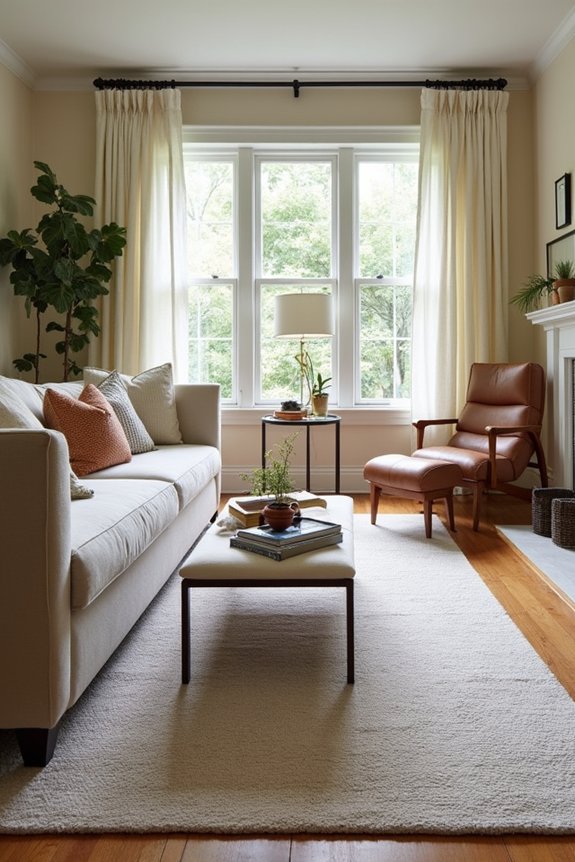
Where do most people go wrong with rug sizing? They choose rugs that feel too small, creating visual chaos instead of cohesion. This mistake shrinks spaces immediately.
Most people choose rugs that feel too small, creating visual chaos instead of cohesion and immediately shrinking spaces.
Here’s what I’d avoid: placing your living room rug too close to walls. Keep at least 24 inches of wall clearance in larger rooms, 18 inches in smaller ones. This breathing room prevents that cramped feeling.
Your rug extending beyond furniture matters too. Make sure it stretches 6–8 inches past your front legs of sofa and chairs. This anchors everything together.
In open-plan spaces, resist using multiple small rugs—they visually shorten the area. Instead, choose a single large rug that unifies zones. For high-traffic areas, thicker rugs prevent bunching and tripping hazards.
Get your rug proportion right, and you’ll change how your space feels.