

Measure your bedroom’s square footage first—multiply length by width—then match the blade span accordingly. Small rooms under 100 square feet need 29–36 inch fans; medium rooms (100–150 sq ft) work with 42–54 inches; larger bedrooms (150+ sq ft) require 56 inches or bigger. Wrong sizing wastes energy and creates uncomfortable drafts or dead zones. Pair your properly sized fan with LED lighting and high CFM ratings for best efficiency. Installation details matter for optimal performance.
Why Bedroom Ceiling Fan Size Matters for Comfort

Have you ever noticed how a ceiling fan in one room feels perfect while the same model leaves another space feeling stuffy? That’s because blade span matters—a lot. When you match your fan’s size to your room size, you get better comfort. A fan that’s too small won’t push air effectively, leaving dead zones where you feel nothing. Too large, and it overwhelms the space, creating uncomfortable drafts. Getting it right means your bedroom actually feels cooler in summer—we’re talking a potential 6–8 degree difference. You’ll breathe easier, sleep better, and use less energy doing it. Think of it like this: the right-sized fan becomes invisible, just doing its job so you can focus on relaxing.
Measure Your Bedroom (Square Footage and Ceiling Height)

Before you pick a fan, you’ll need to measure two things: your room’s square footage and how high your ceiling sits. Grab a tape measure and multiply your room’s length by its width to get the total square footage—this’ll be your main guide for blade span size. Your ceiling height matters too, since it affects how far down the fan hangs and whether it’ll work properly in your space.
Room Dimensions And Layout
Why does measuring your bedroom matter when picking a ceiling fan? Your room’s dimensions directly determine the blade span you’ll need for proper airflow. Taking accurate measurements prevents costly mistakes and leads to a well-fitted installation.
For an 8×10 ft room, prioritize smaller blade spans around 29–39 inches to avoid crowding your ceiling. Medium bedrooms (100–150 sq. ft.) work well with 36–44 inch blades, while larger spaces need 44–54 inches. Your room size dictates the blade span requirements.
Measure carefully. Measuring twice means installing once, and getting the blade span right produces the difference between efficient comfort and wasted energy.
Ceiling Height Considerations
Once you’ve nailed down your room’s square footage, it’s time to look up—literally. Your ceiling height matters just as much as floor space when selecting a fan. I’m talking about safety and airflow efficiency here.
| Ceiling Height | Downrod Length | Blade Height |
|---|---|---|
| 8 feet | None (flush mount) | 7 feet |
| 9-10 feet | 12-18 inches | 8-9 feet |
| 11-14 feet | 24-60 inches | 8-9 feet |
Here’s the formula I use: take your ceiling height in feet, subtract 9, and you’ve got your downrod length. Standard guidance says blades should hang around 7-9 feet from the floor. This spacing prevents head bumps and keeps air circulating properly throughout your bedroom. Measure twice, calculate once—that’s my motto.
Small Bedrooms: Choose a 29–39 Inch Fan

When you’re working with a compact bedroom, I’d recommend staying within the 29–39 inch blade span range because it’ll give you solid airflow without making your space feel cramped or overwhelming. You’ll want to think about where you’re placing the fan—positioning it centrally helps distribute air evenly across the room without creating those awkward dead zones in corners. Since most small bedrooms max out around 100 square feet, a fan in the 29–36 inch range typically works best for keeping your energy bills reasonable while still keeping things comfortable.
Space Efficiency And Airflow
How much space does your bedroom actually have? That’s your starting point. A 29–39 inch ceiling fan size works well for rooms up to 100 square feet because it delivers adequate airflow without feeling cramped. Choosing the lower end—closer to 29 inches—helps maintain better proportion, especially if you’ve got tight ceilings or compact layouts.
Here’s what matters: proper airflow means the fan circulates air evenly without overwhelming your space. When you mount it correctly with adequate downrod clearance, the blades stay safely away from walls and furniture. This setup prevents that awkward, cluttered feeling while keeping everything functional.
The result? You get comfortable air circulation that improves your room’s comfort level without dominating your bedroom’s visual space.
Optimal Blade Span Selection
For rooms up to 100 square feet, a blade span between 29 and 39 inches provides balanced air circulation without excessive air movement. This range performs well on standard 8-foot ceilings with flush mounting, maintaining adequate clearance from the blades.
Smaller blade spans offer practical advantages: reduced noise levels, minimal vibration for better sleep quality, and lower energy consumption that reduces utility costs.
Room Dimensions And Placement
The real question isn’t whether your bedroom needs a ceiling fan—it’s whether you’re picking one that’ll actually fit without looking like an airplane propeller mounted above your pillow.
For small bedrooms, room dimensions matter more than you’d think. I’d recommend sticking with a 29–39 inch ceiling fan size that matches your actual space. If you’re working with a tight 8×8 or 8×10 bedroom, aim for the 29–36 inch range instead. This keeps everything proportional and prevents that cramped feeling.
Here’s the thing: proper placement depends on your room dimensions and ceiling height. A well-sized fan provides adequate airflow without crowding your overhead space or creating visual imbalance. You’ll want at least 7 feet of clearance from the floor to blade tips.
Medium Bedrooms: Choose a 42–54 Inch Fan

When you’re furnishing a medium-sized bedroom—one that’s roughly 100–150 square feet—you’ll want to grab a ceiling fan with a blade span between 42 and 54 inches. This ceiling fan size delivers balanced airflow without making your space feel cramped or overwhelmed. Staying within this blade span range prevents the awkward mismatch of a fan looking too small or too large for your room.
Here’s why this matters: the right blade span optimizes both cooling efficiency and CFM delivery, meaning your fan works smarter, not harder. It’ll keep air circulating evenly throughout your bedroom without creating those annoying dead spots. When you match the fan size directly to your room dimensions, you get a piece that looks proportionate and well-suited to the space. That’s the balance where function meets design.
Large Bedrooms: Choose 56 Inches or Larger

If you’ve got a large bedroom—we’re talking 150 square feet or more—you’ll want to step up to a 56-inch fan or larger to move air across the whole space without creating those annoying hot spots. A bigger blade span does the heavy lifting here; it pushes air more effectively and helps your room feel evenly cooled instead of comfortable in one corner and stuffy in another. Just make sure you match that larger fan with a CFM rating (that’s the cubic feet per minute it moves) that fits your room size, so you’re not wasting energy or leaving gaps in coverage.
Airflow Coverage For Large Spaces
How’s that stagnant corner in your master bedroom working out for you?
I’ll be honest—it’s not ideal. When you’re dealing with a bedroom approaching 200–300 square feet, a standard fan just won’t cut it. You need a blade span of 56 inches or larger to really push air across the entire room. I’m talking about actual airflow coverage, not just ceiling noise.
Here’s why it matters: oversized blades maximize CFM (cubic feet per minute), which means better circulation without dead zones. Your 56-inch fan tackles those problem corners where stagnant air likes to hide. Pair that larger blade span with the right downrod length, and you’ve got balanced airflow throughout your space. That’s when your bedroom finally feels comfortable year-round.
Blade Span Performance Standards
Now that you’ve identified those problem corners, it’s time to match your bedroom size with actual fan performance—and that’s where blade span becomes your practical advantage.
Here’s the reality: a 56-inch or larger blade span delivers the air circulation you need in spacious bedrooms. I’m talking about rooms hitting 300 square feet or beyond. These bigger fans come paired with higher CFM ratings that effectively fill your space more thoroughly than smaller diameters.
Think of blade span as your circulation workhorse. The wider your blades sweep, the more air they push across the entire room. You’re getting balanced airflow instead of dead zones.
Just remember one thing: verify your ceiling height accommodates the downrod length needed for that recommended 8–9 foot hanging height. Get that measurement right, and you’ve completed the job correctly.
Adjust Downrod Length for Ceilings Above 9 Feet
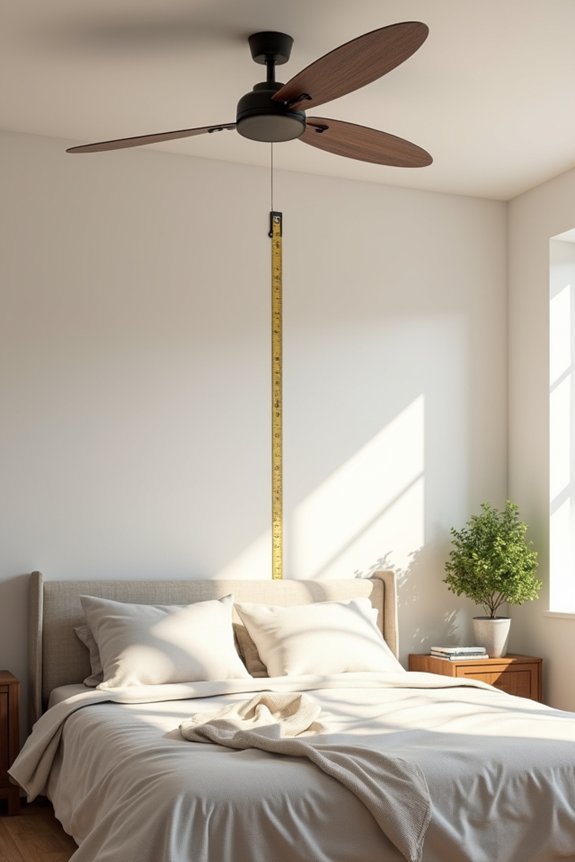
Ceiling fans hanging in rooms with high ceilings need special attention to work properly. I’ll help you figure out the right downrod length for your space.
Here’s what I recommend:
- Measure your ceiling height in feet
- Subtract 9 feet from that measurement
- That number equals your ideal downrod length
- Add a canopy adapter kit if you’ve got sloped or vaulted ceilings
For example, a 12-foot ceiling needs a 3-foot downrod. Taller ceilings—say 13 or 14 feet—typically require 4 to 5-foot downrods instead. The goal is positioning your fan blades around 7 to 9 feet above the floor. This setup provides safe clearance from your head and allows air to circulate throughout your bedroom. Getting this right impacts how well your fan performs.
Keep Blades at Least 7 Feet Above the Floor

You’ll want to mount your fan’s blades at least 7 feet above the floor—this clearance is important for both safety and getting the airflow you’re paying for. When blades sit too low, they can hit you in the head (not fun) and restrict the air circulation that cools your room effectively. Measure from the floor to your blade tips during installation to confirm you’ve met that minimum mark, particularly in bedrooms where head bumps are particularly annoying.
Safety and Clearance Standards
Because proper blade height directly affects both safety and how well your fan actually works, I’ll walk you through what you need to know. Here’s what matters for your bedroom’s blade clearance and ceiling height:
- Maintain at least 7 feet (84 inches) of clearance between blade tips and floor
- Target 8–9 feet of hanging height for standard residential rooms
- Use downrods to bridge the gap between your ceiling and desired blade position
- Consider canopy adapters or extended downrods if you have sloped or cathedral ceilings
Getting this right keeps everyone safe from accidental contact while letting your fan move air efficiently. Your ceiling height determines how much downrod you’ll need. Higher ceilings give you more flexibility, but even standard eight-foot rooms need proper spacing consideration.
Optimal Airflow Performance
Now that we’ve covered the safety requirements, let’s talk about what those measurements actually do for your fan’s performance. Here’s the thing: when your blade span sits between 7 and 9 feet above the floor, your fan actually works the way it’s designed to. The downrod length makes this happen by positioning those blades in the sweet spot for maximum airflow circulation.
Too high or too low, and you’re fighting physics. Blades positioned correctly push air down efficiently, creating that comfortable breeze we all want. I’ve found that getting this height right improves your fan from just spinning to actually cooling your room. It’s one of those details that separates a fan that performs from one that merely exists.
Avoid Furniture Placement Conflicts

Where should I position my ceiling fan to avoid clashing with the furniture you’ve already arranged? Thoughtful placement prevents headaches down the road.
Here’s what I recommend:
- Maintain at least 18 inches of clearance between blade tips and surrounding furniture to prevent wobbling and maintain safe airflow.
- Keep the fan away from clocks, mirrors, and shelving units that vibrations might disturb or destabilize.
- In bedrooms, don’t mount directly above beds or dressers where airflow blows into sleeping areas and personal items.
- Center your fan relative to the primary seating or sleeping zone, minimizing obstructions while maintaining 7–9 feet clearance from the floor.
When choosing ceiling fan size and furniture clearance together, you’re creating a balanced room that works with you, not against you. Measure twice, mount once.
Why CFM Matters for Cooling Your Bedroom
Once you’ve got your fan positioned away from furniture and obstacles, you’ll want to focus on something that actually determines whether it’ll keep you cool: CFM, or cubic feet per minute.
CFM measures how much air your fan moves around the room. Higher CFM ratings mean faster air circulation, which can make you feel 6–8 degrees cooler during hot months. Think of it this way: more air movement equals more comfort.
Here’s the thing—you’ve got to match CFM to your room size. Smaller bedrooms need lower CFM fans, while larger spaces demand higher ratings. Pair a high-CFM fan with a tiny room, and you’ll overpower the space unnecessarily. Get it right, though, and you’re comfortable without wasting energy. That’s the goal worth pursuing.
Flush Mounts vs. Downrods: Which Works for Your Ceiling?

How you mount your ceiling fan matters just as much as which fan you choose—maybe even more, since a poorly mounted fan won’t perform right no matter how good it is.
Your ceiling height determines whether you’ll use a flush mount or downrod. Here’s what I’d consider:
- Flush mounts work best for ceilings around 8 feet—they sit tight against the ceiling
- Downrods (12–18 inches) suit 9–10 foot ceilings and improve airflow significantly
- Longer downrods (24–36 inches) handle 11–12 foot ceilings and maintain that ideal 8–9 foot blade height
- Sloped ceilings need adapter kits to keep proper clearance and performance
You’ll want at least 7 feet of clearance from blades to floor. That’s your safety baseline. Check your ceiling height first—it’ll tell you everything you need to know.
Common Sizing Mistakes That Waste Money and Reduce Airflow

Getting your ceiling height right is only half the battle—the other half is picking a fan that actually fits your room’s size. I see people make this mistake constantly, and it costs them money and comfort.
For bedrooms up to 100 square feet, you need a 29–36 inch ceiling fan size. Jump to 150–300 square feet? Go for 44–54 inches. Pick something too small, and you’re wasting airflow—your room stays stuffy and uncomfortable. Choose something too large for a tiny bedroom, and you’ll create excessive wind draft and annoying noise that keeps you awake.
The real problem? A fan with the wrong blade span simply won’t circulate air effectively. You’ll spend money on something that doesn’t actually cool or heat your space properly.
How to Pick Fan Size for Sloped or Vaulted Ceilings
What if your bedroom ceiling isn’t flat? Sloped ceilings require thoughtful planning to keep your fan working properly. I’ll walk you through the process so you’re not left scratching your head.
Here’s what I recommend:
Use a canopy adapter kit, choose a longer downrod, and adjust the swivel canopy for proper sloped ceiling installation.
- Use a canopy adapter kit designed specifically for angled ceilings
- Choose a longer downrod to maintain the ideal 7–9 feet hanging height
- Adjust the swivel canopy so blades stay parallel to your floor
- Verify your mounting hardware supports both the ceiling angle and fan weight
The key is achieving that flat vertical drop. When blades hang parallel to the floor, you’ll get efficient airflow instead of wasted energy. Many fans offer sloped-ceiling options, so check before buying. Proper installation makes what seems complicated straightforward and manageable.
Energy Efficiency: Choosing the Right Fan Size for Your Goals

Once you’ve got your sloped ceiling sorted out, picking the right fan size becomes your next consideration for keeping energy bills in check. Matching your blade span to your room size directly impacts energy efficiency.
| Room Size | Blade Span | Energy Benefit |
|---|---|---|
| Up to 100 sq ft | 29–36 inches | Maximizes airflow |
| 150–300 sq ft | 44–54 inches | Better air movement |
| Oversized fans | Any | Wastes energy |
The right-sized fan reduces cooling costs by making your room feel 6–8 degrees cooler without cranking your HVAC harder. Undersized fans struggle inefficiently, eating electricity. I recommend pairing your properly sized fan with an energy-efficient model featuring LED lighting and high CFM per watt ratings. This combination improves your energy bills.
Next Steps: Installation, Mounting, and Smart Controls

Now that you’ve picked the right fan size for your bedroom, it’s time to get it mounted properly—because even the right fan won’t work if it’s hanging too low or installed on the wrong type of ceiling.
Here’s what to focus on:
- Check your downrod length against your ceiling height to hit that 8–9 feet hanging sweet spot
- Verify your mounting bracket works with your ceiling type (drywall anchors versus joists matter)
- Install a smart controller for convenient speed adjustments without leaving bed
- Test blade clearance to maintain at least 7 feet from blades to floor
Once mounted correctly, your fan delivers the airflow and comfort you need. Smart controls make everything easier.